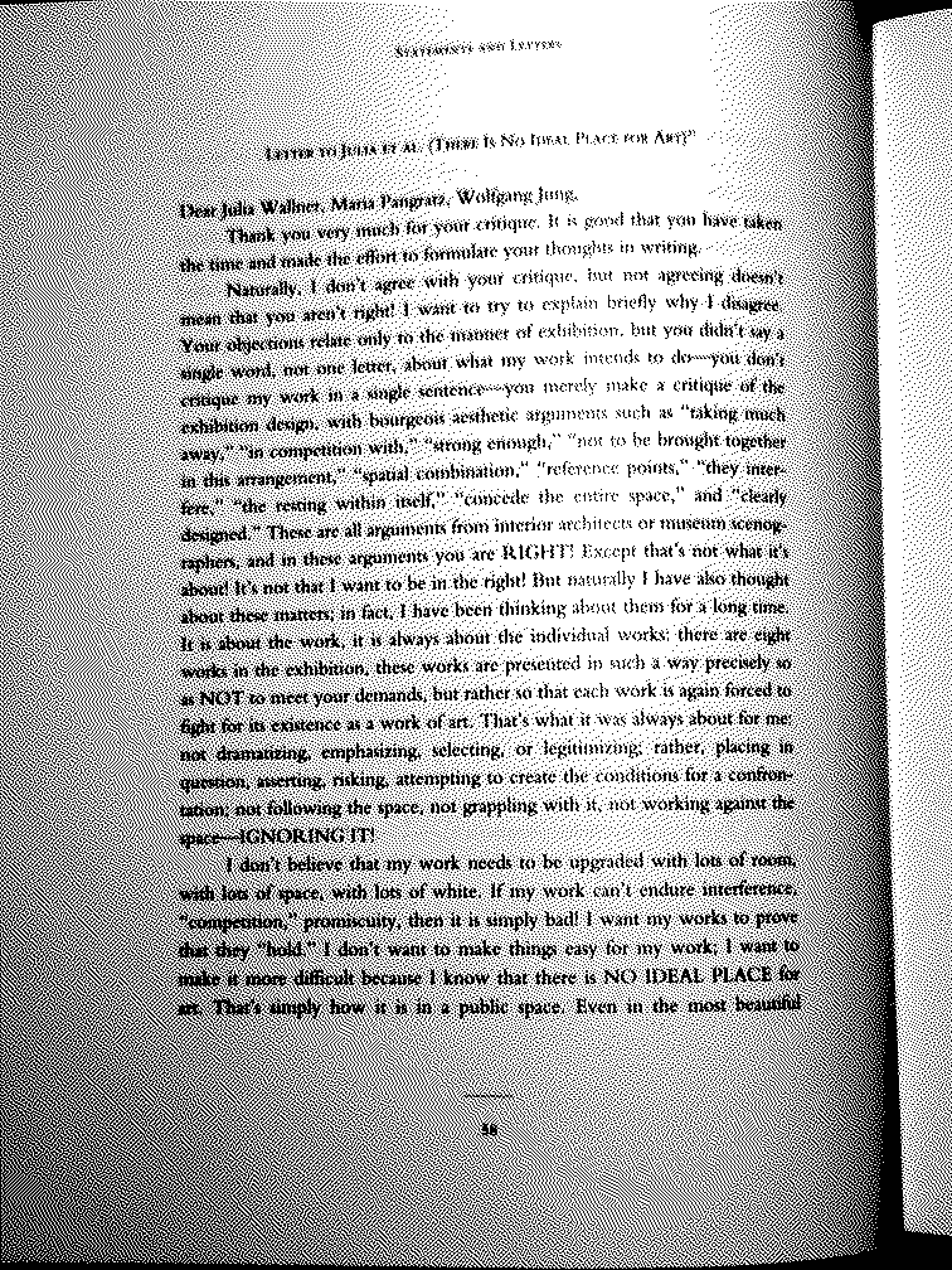
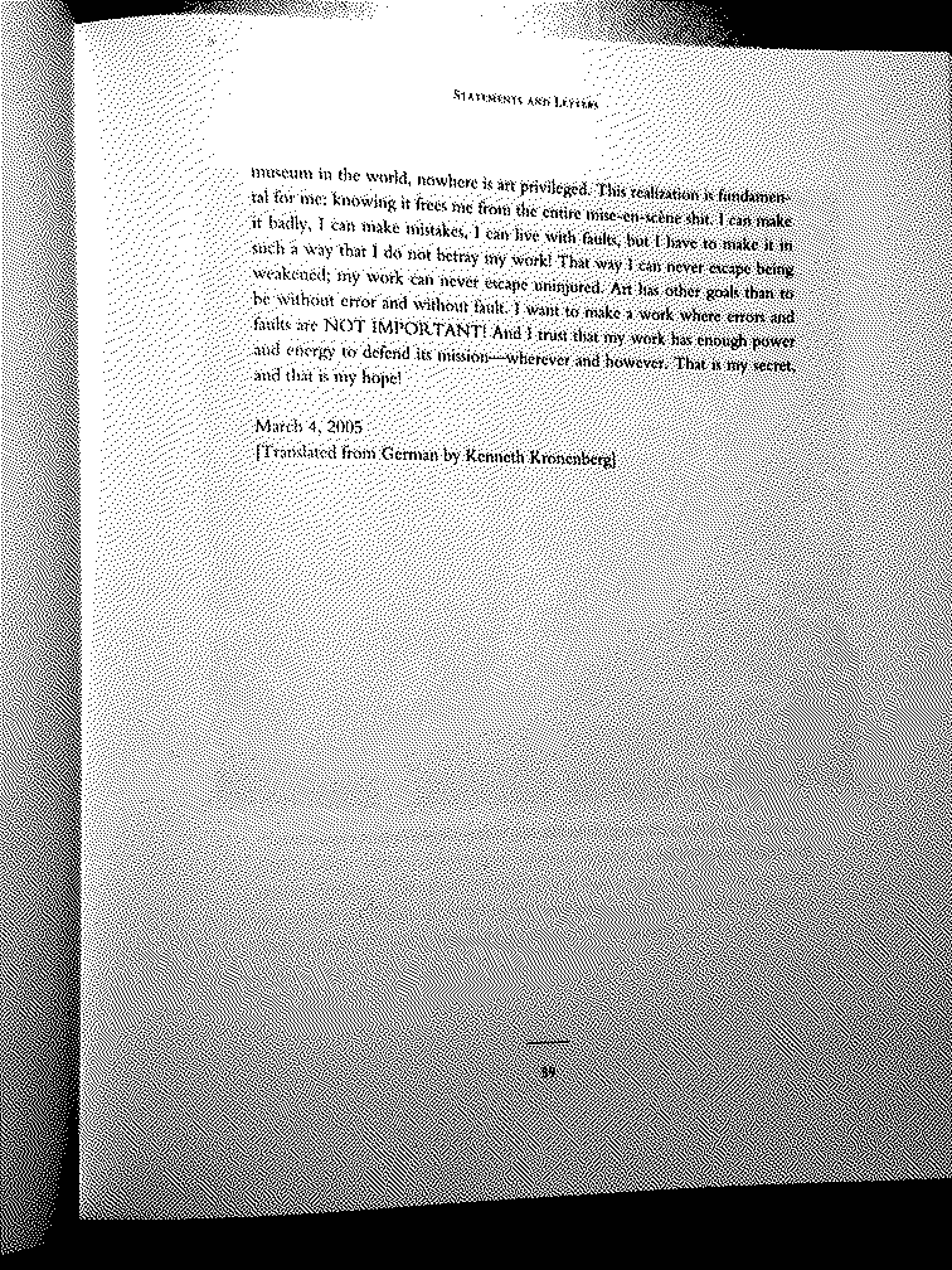
This image shows an open book with text on both pages, displayed in a high-contrast, black-and-white, possibly dithered or photocopied style. The pages are brightly lit, making the text appear dense, and the book is set against a dark background.Dear Julia Wallner, Maria Pangratz, Wolfgang Jung, Thank you very much for your critique. It is good that you have taken the time and made the effort to formulate your thoughts in writing. Naturally, I don't agree with your critique, but not agreeing doesn't mean that you aren't right! I want to try to explain briefly why I disagree. Your objections relate only to the manner of exhibition, but you didn't say a single word, not one letter, about what my work intends to do—you don't critique my work in a single sentence-you merely make a critique of the exhibition design, with bourgeois aesthetic arguments such as "taking much away," "in competition with," "strong enough," "not to be brought together in this arrangement," "spatial combination," "reference points," "they inter-fere," "the resting within itself," "concede the entire space," and "clearly designed." These are all arguments from interior architects or museum scenog-raphers, and in these arguments you are RIGHT! Except that's not what it's about! It's not that I want to be in the right! But naturally I have also thought about these matters; in fact, I have been thinking about them for a long time. It is about the work, it is always about the individual works: there are eight works in the exhibition, these works are presented in such a way precisely so as NOT to meet your demands, but rather so that each work is again forced to fight for its existence as a work of art.That's what it was always about for me: not dramatizing, emphasizing, selecting, or legitimizing; rather, placing in question, asserting, risking, attempting to create the conditions for a confron-tation; not following the space, not grappling with it, not working against the space-IGNORING IT! I don't believe that my work needs to be upgraded with lots of room, with lots of space, with lots of white. If my work can't endure interference, "competition," promiscuity, then it is simply bad! I want my works to prove that they "hold." I don't want to make things easy for my work; I want to make it more difficult because I know that there is NO IDEAL PLACE for art. That's simply how it is in a public space. Even in the most beautiful museum in the world, nowhere is art privileged. This realization is fundamental for me; knowing it frees me from the entire mise-en-scène shit. I can make it badly, I can make mistakes, I can live with faults, but I have to make it in such a way that I do not betray my work! That way I can never escape being weakened; my work can never escape uninjured. Art has other goals than to be without error and without fault. I want to make a work where errors and faults are NOT IMPORTANT! And I trust that my work has enough power and energy to defend its mission-wherever and however. That is my secret, and that is my hope! March 4, 2005 [Translated from German by Kenneth Kronenberg]
LETTER TO JULIA ET AL. (THERE IS NO IDEAL PLACE FOR ART), Thomas Hirschhorn